
Classic American cars and the 40-year rule
Two exemptions, two dates. The 40-year rule is simple once you see what each one measures.
Three things catch people out. A tidy restoration can lose the exemption, the MOT and tax dates are not the same, and the line moves every year. All three are true, and none is hard to check. The 40-year rule is two separate exemptions that look at two separate things.
Two exemptions, two tests
The MOT exemption applies to a vehicle built or first registered more than 40 years ago, as long as it has not been substantially changed. It is a rolling date, so each year another model year becomes eligible. The tax exemption works from a fixed cut-off instead: built before 1 January of a given year, applying from the following 1 April.
- MOT exemption
- Built or first registered more than 40 years ago, and no substantial change
- Vehicle tax in 2026
- Built before 1 January 1986, from 1 April 2026
- Build date unknown
- Registered before 8 January 1986 qualifies for the tax exemption
- Tax class
- You apply to move the car into the historic class. It does not happen by itself
In plain terms, a US car built in 1985 or earlier clears the tax test this year. The MOT test is measured from the individual car's build or first registration date, so the cars either side of the line are worth checking one at a time.
Where popular models fall in 2026
- Over 40 years old
- Early builds over 40
- Over 10 years old
- Either side of 10 years
- Under 10 years old
-
Ford Mustang: Gen 1, 1964.5-1973, over 40 years old. Gen 2, 1974-1978, over 40 years old. Gen 3, 1979-1993, early builds over 40. Gen 4, 1994-2004, over 10 years old. Gen 5, 2005-2014, over 10 years old. Gen 6, 2015-2023, either side of 10 years. Gen 7, 2024-present, under 10 years old.
Gen 1 and Gen 2 in full, plus 1979-85 builds from Gen 3.
-
Chevrolet Corvette: C1, 1953-1962, over 40 years old. C2, 1963-1967, over 40 years old. C3, 1968-1982, over 40 years old. C4, 1984-1996, early builds over 40. C5, 1997-2004, over 10 years old. C6, 2005-2013, over 10 years old. C7, 2014-2019, either side of 10 years. C8, 2020-present, under 10 years old.
C1, C2 and C3 in full, plus MY1984-85 cars from the C4.
-
Chevrolet Camaro: Gen 1, 1967-1969, over 40 years old. Gen 2, 1970-1981, over 40 years old. Gen 3, 1982-1992, early builds over 40. Gen 4, 1993-2002, over 10 years old. Gen 5, 2010-2015, over 10 years old. Gen 6, 2016-2024, either side of 10 years.
Gen 1 and Gen 2 in full, plus 1982-85 builds from Gen 3.
Model years as commonly quoted. A generation is never simply in or out: only the first years of a run are. Exact start dates vary by a few months, and the test applies to the car in front of you, so we read the build plate and the title before we say yes.
The rule belongs to the car, not the model. Check the build date, not the badge
What counts as a substantial change
A car that has been substantially changed loses the MOT exemption. The test is whether the technical characteristics of a main component were changed within the last 30 years. The main components are the chassis or frame, the monocoque shell, the axles or running gear, and the engine.
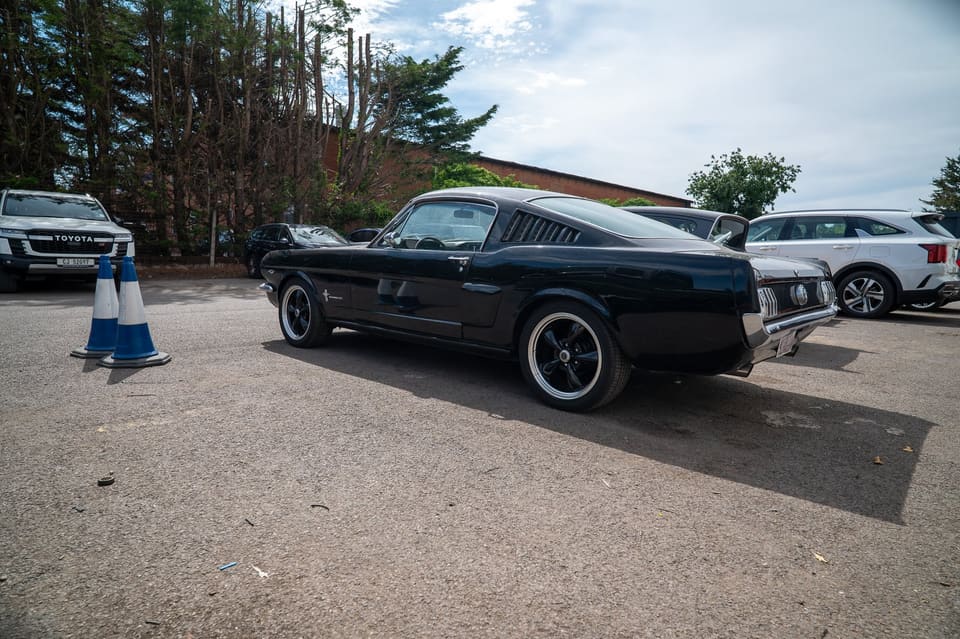
There are exceptions, and they matter for American classics. A change that is correct for the period does not count against you. Nor does one that improves safety or the car's impact on the environment. A rebuilt original engine or a period-correct replacement is not the same as dropping a modern crate motor and a new rear axle into a 1960s shell.
Plenty of US classics have had one of those swaps in their 40 years. If yours has, ask us before you buy. A car that has lost the exemption needs an MOT like any other, and it is better to know that before the money moves.
What still needs checking
The exemption removes the annual test. It does not remove everything else.
-
Roadworthiness
The car must still be kept roadworthy. An exempt car is not an excused one. We carry out MOTs on site for the cars that need one.
-
Lights
Only vehicles first used before 1 September 1965 may keep red rear indicators combined with the stop or tail lamps. A later car needs amber. A rear fog lamp applies to cars first used on or after 1 April 1980. Converting a US car covers the work.
-
Proof of age
DVLA wants the original foreign registration certificate. If the title is missing, it might accept a letter from the manufacturer or an enthusiast club showing the manufacture date.
-
Declaring it
You claim the MOT exemption when you tax the car, and you apply to move it into the historic tax class. The registration page shows where this sits in the DVLA process.
Approval, duty and London run on other dates
| Rule | What it asks |
|---|---|
| Vehicle approval | No 40-year rule. A car with eight seats or fewer that is over ten years old is already exempt, so 40 years adds nothing. IVA or MOT explains the split. |
| Import duty | A car over 30 years old can be treated by HMRC as a collector's piece, which can mean no duty and an effective 5% VAT. HMRC decides, and a mass-produced car from the late 1980s can fail the originality and out-of-production tests. HMRC recommends a ruling first. See customs, duty and VAT. |
| London ULEZ | Exempt if built before 1 January 1973, or over 40 years old and in the DVLA historic tax class. The ULEZ guide has the detail. |
| Clean Air Zones | Historic vehicles get an automatic national exemption. |
Check the car's date against each rule rather than assuming one answer covers all of them. Our costs page shows what goes into a quote.
Before you buy
Send us the make, model, year and anything you know about rebuilds, and we will tell you which exemptions the car is likely to qualify for, what the paperwork needs to show, and what the lights will need. We would rather say "this one is borderline" before you wire a deposit than after the car lands.
DVLA, DVSA and HMRC set the rules, and we cannot promise how they will treat an individual car. What we can do is spot the problems early. Ask us for a quote and we will start with the date.
Quick answers
Does a 40-year-old American car need an MOT?
Not once it is registered, if it was built or first registered more than 40 years ago and has not been substantially changed. You declare the exemption when you tax it, and the car still has to be kept roadworthy.
Is the 40-year rule the same for MOT and vehicle tax?
No. They use different tests. The MOT exemption rolls from the 40-year point of build or first registration. The tax exemption looks at whether the car was built before 1 January of a cut-off year, which in 2026 is 1 January 1986. A car can qualify for one and not the other.
Does a restored or modified classic still qualify?
It can, if the changes were period-correct or were safety or environmental improvements. A replacement chassis, shell, axles or engine that changed the technical characteristics within the last 30 years is the usual reason a car loses the exemption.
Does the 40-year rule mean I can skip the approval test?
There is no 40-year rule for approval. Cars with eight seats or fewer that are over ten years old do not need one, so for a classic the question never comes up.
What if the car has no paperwork showing when it was built?
DVLA wants the original foreign registration certificate. If you do not have it, it might accept a letter from the manufacturer or an enthusiast club as proof of the manufacture date. Tell us at the quote stage, so we can plan around it.